Showing posts with label Most Deadly Snakes. Show all posts

Inland Taipan

The Inland Taipan is the most venomous land snake on Earth.The average venom yield is 44 mg, 110 mg being the largest recorded, and the venom has a mouse LD50 of 0.03 mg/kg. Its venom is 200-400 times more toxic than most rattlesnakes and 50 times as toxic as a cobra. The Inland Taipan has neurotoxic venom that could potentially kill an adult human in 45 minutes.

There have been no documented human fatalities; bites were treated using antivenom. As of late 2003, all bites positively identified as having been caused by the Inland Taipan have occurred in herpetologists handling the snake, although there are many case reports of bites likely caused by the species.
Full Story >>

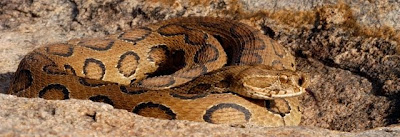
Russell's viper

The amount of venom produced by individual specimens is considerable. Reported venom yields for adult specimens range from 130–250 mg to 150–250 mg to 21–268 mg. For 13 juveniles with an average length of 79 cm, the average venom yield was 8–79 mg (mean 45 mg).

The LD50 in mice, which is used as a general indicator of snake venom toxicity, is as follows: 0.08–0.31 μg/g intravenous, 0.40 μg/kg intraperitoneal, 4.75 mg/kg subcutaneous. For most humans a lethal dose is 40–70 mg. In general, the toxicity depends on a combination of five different venom fractions, each of which is less toxic when tested separately. Venom toxicity also varies within populations and over time.

Envenomation symptoms begin with pain at the site of the bite, immediately followed by swelling of the affected extremity. Bleeding is a common symptom, especially from the gums, and sputum may show signs of blood within 20 minutes post-bite. There is a drop in blood pressure and the heart rate falls. Blistering occurs at the site of the bite, developing along the affected limb in severe cases. Necrosis is usually superficial and limited to the muscles near the bite, but may be severe in extreme cases. Vomiting and facial swelling occurs in about one-third of all cases.

Severe pain may last for 2–4 weeks. Locally, it may persist depending on the level of tissue damage. Often, local swelling peaks within 48–72 hours, involving both the affected limb and the trunk. If swelling up to the trunk occurs within 1–2 hours, massive envenomation is likely. Discoloration may occur throughout the swollen area as red blood cells and plasma leak into muscle tissue. Death from septicaemia, respiratory or cardiac failure may occur 1 to 14 days post-bite or even later.
Full Story >>

Eastern Brown Snake

The Eastern Brown Snake is the second most venomous land snake in the world after the Inland Taipan. Their venom is very toxic, and can be fatal; even juveniles have caused human fatalities. The venom contains both neurotoxins and blood coagulants.

Eastern Brown Snakes are also aggressive. Compared to most snakes that will flee when ever possible, Brown Snakes are much more likely to stand their ground, heightening the danger in an encounter. Without medical treatment, death is highly likely.
Full Story >>

Coastal Taipan

The coastal taipan is the fourth most venomous land snake in the world and arguably the largest venomous snake in Australia. Its venom contains taicatoxin, a highly potent neurotoxin. The danger posed by the coastal taipan was brought to Australian public awareness in 1950, when young herpetologist Kevin Budden was fatally bitten in capturing the first specimen available for antivenom research. The coastal taipan is often considered to be one of the deadliest species in the world.


Full Story >>

Philippine Cobra

Drop by drop, the Northern Philippine Cobra has the most potent venom of all the species in the genus Naja. The venom is mainly composed of neurotoxins. The postsynaptic neurotoxins interrupt the transmission of nerve signals by binding to the neuro-muscular junctions near the muscles. The symptoms might include headache, nausea, vomiting, abdominal pain, diarrhoea, dizzyness, collapse, convulsions.

Particularly in children, collapse and convulsions may be the first evidence of envenoming, at least for certain species. It is often assumed that hypotension will occur in response to envenoming, but hypertension is also common and both tachycardia and bradycardia are reported. Complete respiratory failure leads to victim's death.
Full Story >>

Indian Cobra

The Indian Cobra is the world's longest venomous snake, with a length up to 5.6 m (18.5 ft). Thesnake is responsible for the greatest number of human deaths caused by snakebite in South Asia.

The King Cobra's venom, which is composed mostly of proteins and polypeptides, is produced in specialized salivary glands located just behind the animal's eyes (as in other snakes). When biting its prey, venom is forced through the snake's half-inch (1.25 cm) fangs and into the wound. In the past, King Cobra venom was treated as 1.7 mg/kg in LD/50 value (which is one of the least toxic elapids.) However, this is not always true. According to the recent toxinology study, the LD/50 of Chinese King Cobra venom is 0.34 mg/kg-0.46 mg/kg which means it is more venomous than most of the other cobra species, like chinese cobra. Although this toxicity is still weaker than some of the other elapids (like taipan, krait, etc), King Cobras can deliver larger quantities of venom than most other species. It injects 380-600 mg of venom(which is enough to kill 20-40 grown men) in a single bite, and can even kill an elephant within 3 hours. One bite from a King Cobra can cause death within 15 minutes for a human. However, death usually occurs between 30-45 minutes.

The King Cobra's venom is primarily neurotoxic and thus attacks the victim's central nervous system and induces severe pain, blurred vision, vertigo, drowsiness, and paralysis. Envenomation progresses to cardiovascular collapse, and the victim falls into a coma. Death soon follows because of respiratory failure. There are two types of antivenom made specifically to treat King Cobra envenomations. The Red Cross in Thailand manufactures one, and the Central Research Institute in India manufactures the other; however, both are made in small quantities and are not widely available. Ohanin, a protein component of the venom, causes hypolocomotion and hyperalgesia in mammals. Other components have cardiotoxic, cytotoxic and neurotoxic effects.

Despite the King Cobra's fearsome reputation and deadly bite, it is a shy and reclusive animal, avoiding confrontation with humans as often as possible. There are other venomous snakes within this species' range, in fact, that are responsible for more fatal snake bites than the King Cobra, such as the Monocled Cobra, or Russell's Viper .

In Burma, King Cobras are often used by female snake charmers. The charmer is usually tattooed with three pictograms using an ink mixed with snake venom; superstition holds that it protects the charmer from the snake. The charmer kisses the snake on the top of its head at the end of the show.

Full Story >>

Black Mamba

Black Mamba, is an elapid snake and is one of Africa's most dangerous and feared snakes. Black mambas are among the most venomous snakes in Africa, with a LD50 of 0.25 mg/kg. A bite from a black mamba delivers about 100–120 mg of venom on average; however it can deliver up to 400 mg. About 10-15 mg of its venom is enough to kill an adult. The initial symptom of the bite is local pain in the bite area, although not as severe as in a bite from snakes with cytotoxins.

The victim soon experiences a tingling sensation in the mouth and extremities, dizziness, erratic heartbeat, ptosis, diplopia (double vision), dysphagia, tunnel vision, ophthalmoparesis, severe confusion, dysarthria, fever, diaphoresis (excessive perspiration), excessive salivation (including foaming of the mouth and nose), and pronounced ataxia (lack of muscle control). If the victim does not receive medical attention, symptoms rapidly progress to severe abdominal pain, nausea and vomiting, lymphadenopathy, severe dyspnea (shortness of breath), epistaxis, pallor, shock, nephrotoxicity, cardiotoxicity, and paralysis. Eventually, the victim experiences convulsions, cardiac arrest, respiratory arrest, coma, and then death. Without antivenom, the mortality rate nears 100%, the highest among venomous snakes.

Depending on the nature of the bite, death can result at any time between 15 minutes and 3 hours. On average, however, death usually occurs 30 to 60 minutes after envenomation. Factors associated with the nature of the bite include penetration of one or both fangs, amount of venom injected, location of the bite, and proximity to major blood vessels. The health of the snake and the interval since it last used its venom mechanism may also be factors. The health, size, age, and psychological state of the individual bitten is also a determining factor.
Full Story >>

Tiger Snake

Tiger snakes possess a potent neurotoxin, coagulants, haemolysins and myotoxins, and rank amongst the deadliest snakes in the world. Symptoms of a bite include localized pain in the foot and neck region, tingling, numbness, and sweating, followed by a fairly rapid onset of breathing difficulties and paralysis. While antivenom is effective, mortality rate for this species is over 60% if not treated.

Treatment is the same for all deadly Australian snakes. The Pressure Immobilization Method (PIM) is used to inhibit the flow of venom through the lymphatic system. Broad thick bandages are applied over the bite, then down and back along the limb to the armpit or groin. The affected limb is then immobilized with a splint. Identification of the venom is possible if traces are left near the wound. You do not need to identify the snake if bitten in Tasmania, however, as the same antivenom is used to treat all Tasmanian snakes' bites. The availability of antivenom has greatly reduced the incidence of fatal tiger snake bites, the number of deaths is now exceeded by the Brown snake.
Full Story >>

Common Krait

After Indian Kobra, Common Krait is responsible for the greatest number of human deaths due to snake bite in South Asia.
Krait venom is extremely neurotoxic and quickly induces muscle paralysis. Clinically, their venom contains pre-synaptic neurotoxins. And it is many times more venomous than that of the common cobras.These neurotoxins generally affect the nerve endings near the synaptic gap of the brain. Fortunately, since kraits are nocturnal they seldom encounter humans during daylight hours, so incidents are rare. Note that there is frequently little or no pain from a krait bite and this can provide false reassurance to the victim.

Typically, victims complain of severe abdominal cramps, accompanied by progressive paralysis. As there are no local symptoms, a patient should be carefully observed for signs of paralysis (eg the onset of ptosis) and treated urgently with antivenom. Note that it is also possible to support bite victims via mechanical ventilation, using equipment of the type generally available at hospitals. Such support should be provided until the venom is metabolised and the victim can breathe unaided. If death occurs it takes place approximately 6-8 hours after the krait bite. Cause of death is general respiratory failure i.e. suffocation.
Full Story >>

Pets for sale - Latest ads